Fallaci was above all a woman without compromise. A woman who has built his life on the substance, often risking a lot in first-person. It 'was a woman who worked, loved, written, fully lived his life from early childhood when the relay was partisan (Other than fascist). Certainly it has never been a Marxist-Leninist, and that in Italy is certainly not considered intrinsic reason, but it certainly was an excellent example of anti-Fascist Women, a feminist. Feminist for real, not in words . There is no doubt that hated to part boorish, truculent, and the left for our local coherence. A bank that has not found consistency in the politically correct. Even going back in time. Just remember in one of his interviews when Khomeini before him (in Iran in Paris) had the nerve to stand by the head of the chador and almost throw him in the face. It would be really curious to compare the authentic feminism Fallaci with that of many other current phony "suffragettes" that magically lose their boldness when it comes to opine something against some well-known fundamentalist habits ... Distinguish: the fundamentalist our own are being dried, progressive reprimente. Some foreign fundamentalism, say "exotic" are deserving of comprehension if not complete silence. If it is true that for some men has lost the stencil a similar story can be done even in the women's field.


Who has read the books suggested above will know exactly who were the people interviewed: Many Middle Eastern leaders (Arafat, Habash G., Hussein of Jordan, Khomeini, Reza Pahlavi), Vietnamese leaders, Chinese , American (Bob Kennedy, Martin Luther King, William Colby), Italian (Andreotti, Nenni, Berlinguer). In short, there is everything. But he also knew to be a writer superfine. No space to abstruse terminology to show how he had studied or bed, but great ability to get to the bottom of the issues without ever missing his point of view of women. In that respect it was very similar to Montanelli (apart from the feminine sensibility, of course ...). No coincidence that both were selling lots of books and both were in Tuscany.
Chronologically speaking the first book of this "trilogy" Nothing is so . Fallaci is the testimony of the key moment of the war in Vietnam, or the years 1967/68, but also contains what she saw during the repression of the Mexican government in coincidence with the student protests against the Olympics in Mexico City. During dramatic experience that Fallaci was hurt.
The book is very interesting because it does not provide a unidirectional view of the events narrated. Moreover, the journalist was able to interview representatives of both warring parties. And it was always (or almost) in the heart of the action. The next is
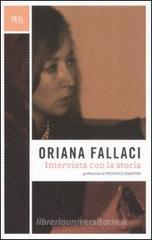
Interview With History and contains a long series of interviews with the most prominent of the years 60/70, always following a logical as the reader can well understand by reading the book (quite large , over 870 pages). The style is typical of Fallci, pressing questions, and no escape for respondents. It must be said that some of these seem to be very good actors. Finally, we
Interview with Power, text to forbid a bit like a continuation of the previous year. The book contains two excellent interviews with Gaddafi and Khomenini (as well as Bob Kennedy, the Dalai Lama, Enrico Berlinguer, Sandro Pertini, Deng Xiaoping and others).
short, those who had not read them I suggest you fix it.
And in any case I hope I have given a personal point of view, without necessarily having issued the usual "review".


0 comments:
Post a Comment